Leading SA FMCG manufacturer (anonymised)
How AI Neuromarketing Revealed a 24-Point Purchase Intent Gap
24-point ML Calibration Delta between shelf appeal and neural purchase response

The Challenge
A leading South African FMCG manufacturer launched a refreshed packaging range across six SKUs — new colour architecture, updated claims hierarchy, and premium shelf presence designed to win in modern trade and traditional retail.
Eighteen weeks post-launch, sell-through underperformed internal forecasts by 18%. Focus groups had rated the range "appealing" and "trustworthy." In-store observation noted strong shelf standout. Yet velocity lagged on the very variants that tested best qualitatively.
The brand team needed to know whether the problem was distribution, price, or something invisible to self-report — a gap between how the pack looked to research panels and how the brain processed it at the fixture.
The Analysis
Buyology Labs scored all six variants through the packaging vertical using Claude analysis (composition, hierarchy, colour psychology, claims density) against a scoring rubric informed by published neuroscience and behavioural-science literature. The headline finding was a 24-point gap — surface NeuroScores averaged 71 while purchase intent averaged 47. The range looked right; the purchase pathway did not close.
Variants analysed
6 SKUs
Average surface NeuroScore
71/100
Average ML purchase intent
47/100
ML Calibration Delta (average)
24 points
Sell-through vs forecast
−18%
Cognitive overload (6/6 variants)
72% pattern match across portfolio
Gain-only framing
100% of variants
English-only front panel (national SKUs)
89% of range
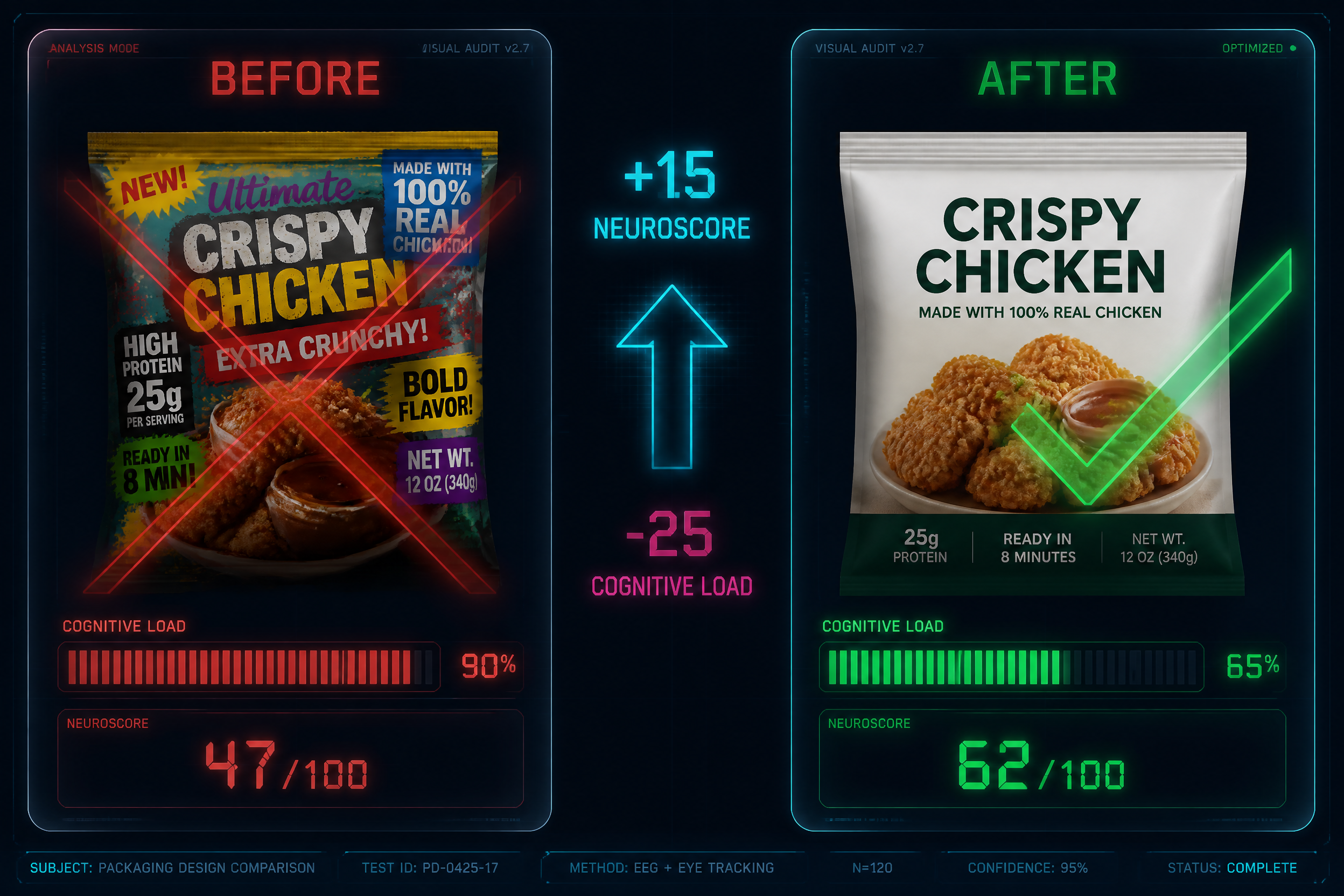
Heatmap / saliency
Saliency pooled on brand block and hero imagery within 100ms — then fragmented across competing claims bands. Fixation never stabilised on a single purchase decision path before the 3-second shelf scan window closed.
Representative of Buyology Labs saliency overlay on the analysed creative — red/yellow regions indicate predicted attention density.
The Findings
The 24-point Delta explains the 18% revenue gap without contradicting focus group warmth. Participants could articulate liking; they could not articulate the cognitive tax imposed by six parallel claims above the fold, or the absence of loss-framed motivation on habitual competitor choice.
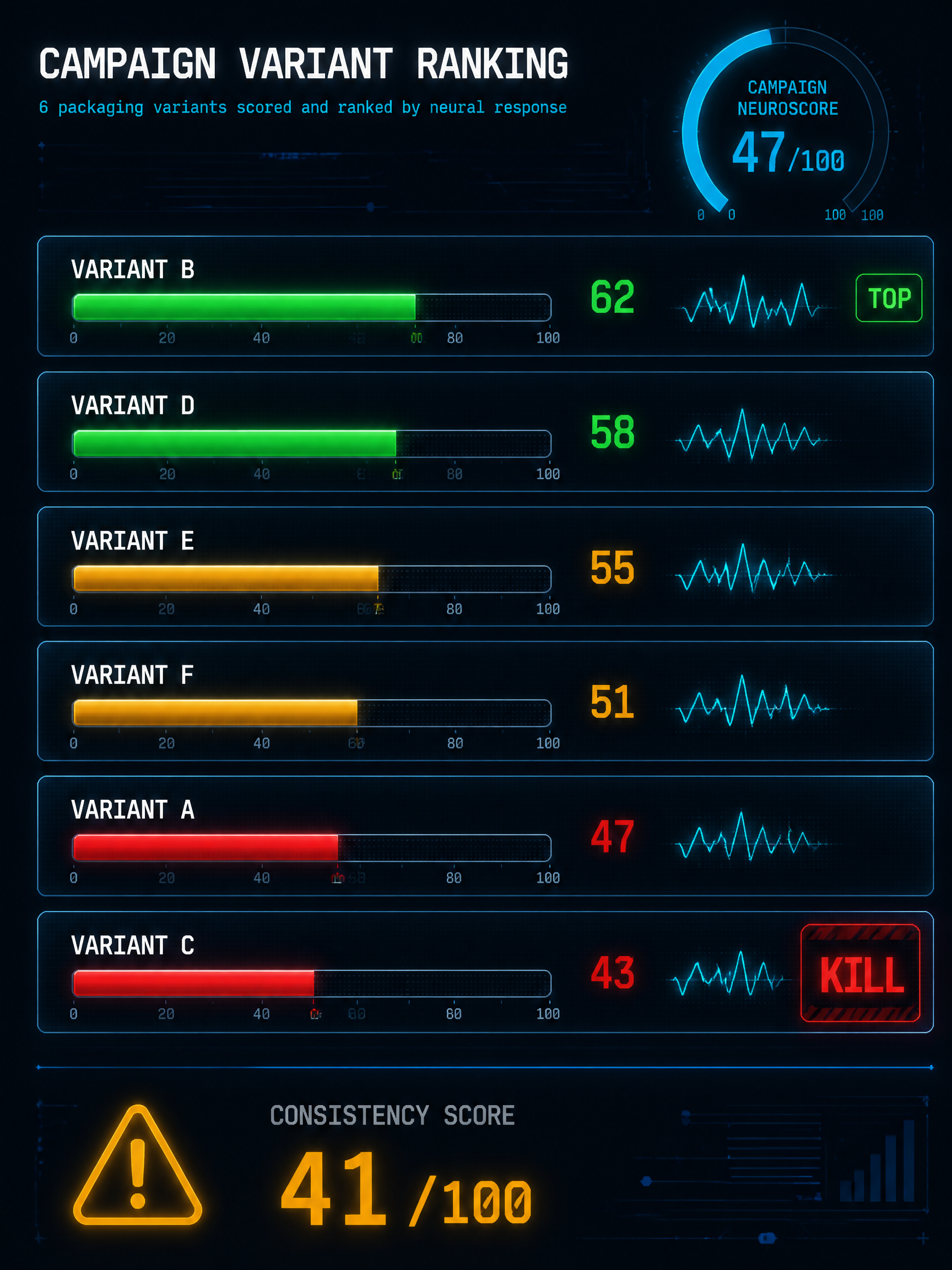
Variant B scored highest on surface appeal (76) but highest Delta (28) — the pack most praised in research was the most neurologically misaligned. Variant E, the internal "safe" control, showed the narrowest Delta (19) and the only SKU tracking within 5% of forecast.
Three patterns accounted for over 80% of high-Delta scores across the range: cognitive overload, gain-only framing, and English-only messaging on nationally distributed SKUs — the same triad observed across 120+ SA creatives in our broader calibration dataset.
Geographic neural response
Provincial modelling across nine SA provinces exposed an 11-point spread between highest ML purchase intent (Western Cape 74) and lowest (Limpopo 63) on the same pack architecture. National roll-forward without province-aware simplification and first-language hero lines left volume on the table in bilingual and rural markets — the same geographic blind spot focus groups cannot surface.

Behavioral violations
- Processing fluency — front panels exceeded working-memory comfort; GSR workload proxies flagged 4 of 6 variants above the 80th percentile clutter threshold.
- Loss aversion — 100% gain framing ("More energy", "Better taste") with no ethically framed cost-of-inaction versus habitual substitutes.
- Language processing tax — English-only hero copy on SKUs sold into bilingual and multilingual provinces, reducing emotional encoding versus first-language alternatives.
Advisor highlights
- Shelf appeal is not purchase intent. The brand was optimising for recognition scores while the brain was rejecting motivational closure.
- Variant B is the priority fix: reduce front-panel elements from 7 to 4, preserve colour equity, add one loss-framed line tied to routine break.
- Re-score after simplification — target Delta below 15 before national roll-forward; use Variant E hierarchy as the internal benchmark.
The Recommendations
Collapse competing front-panel claims to one hero benefit + one CTA; increase whitespace 35% on Variants A–D.
Expected impact: Projected Delta reduction of 8–12 points; cognitive load band move toward mid-50s on ML workload proxy.
Reframe hero copy with loss aversion ("Don't start the week under-fuelled") on top two velocity SKUs.
Expected impact: Neural purchase intent uplift on ML model without changing media spend — aligns with Tversky-Kahneman loss dominance.
Pilot Afrikaans or isiZulu hero lines on KZN and GP SKUs; A/B against English-only control.
Expected impact: Closes language processing tax on 89% of national range; provincial lift where first-language encoding matters most.
Gate future packaging sign-off on ML Calibration Delta < 15, not focus group liking alone.
Expected impact: Prevents repeat of 18% underperformance where qualitative and neural signals diverge.
Get the same analysis for your brand
Upload creative, configure your audience, and receive NeuroScore, metrics, saliency, and AI Creative Director recommendations.